Many homeowners think that installing a fence is a simple household task. It seems just as easy as planting a tree or setting up garden furniture. However, from the perspective of Bulgarian law, this is a mistake.
In Bulgaria, every fence is considered a construction. Its installation is strictly regulated by the state. The main document that defines the rules is the Spatial Planning Act (ZUT).
Ignorance of these rules does not exempt you from responsibility. The consequences of illegal construction can be serious: you may be required to dismantle the new fence at your own expense and also face fines from the municipality for unauthorized construction.
To avoid problems and conflicts with neighbors, you need to know your rights and obligations. In this article, we will outline the basic rules. You will learn when a construction permit is required for a fence and when you can build freely.
Main Law: ZUT and Permissible Height
All construction requirements are described in the Spatial Planning Act (ZUT). In conversation, people often simply call it the “fence law.”
The law clearly defines what kind of fence you are allowed to install. The most important parameter that municipal inspectors look at is height.
Golden standard – 2.20 meters
According to Article 48 of ZUT, there are strict height restrictions for fences. If your plot faces a street, the rules are as follows:
Solid part (plinth): The solid part of the fence (concrete base or brick wall) must not exceed 0.60 m from the sidewalk level.
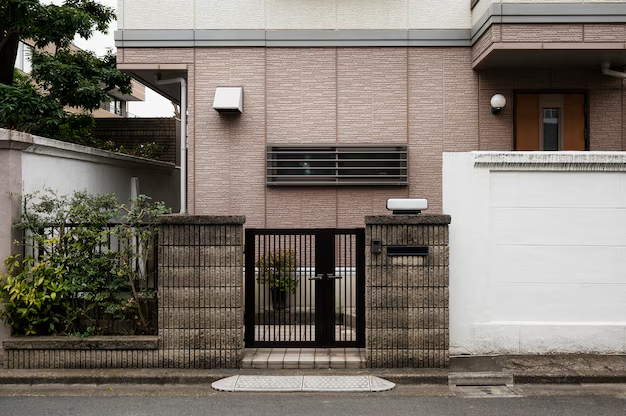
Transparent part: Anything above 0.60 m must be permeable (openwork), such as metal profiles, mesh, wrought iron, or louvers.
Total height: The upper edge of the fence must not exceed 2.20 m.
What if I want a taller or fully solid fence?
Many people want to completely block the street view with a high wall. The law allows this, but the procedure is more complicated.
If you go beyond the “golden standard” (for example, a solid wall 2 m high), you will need a full architectural project approved by the Chief Architect of the municipality. Without this project, the fence will be considered illegal.
When is a construction permit required?
It is important to understand the difference. In Bulgaria, almost every permanent fence requires a construction permit. However, the path to obtain this document can be simplified or full.
Simplified procedure (Article 147 ZUT)
Good news: for most fences, you do not need a full investment project (as you would for a house).
The law (Art. 147 ZUT) allows the construction of fences under a simplified scheme. You only need:
Proof of ownership (notarial deed)
Design visa (sketch) from the Chief Architect
Structural opinion from a civil engineer
This applies to all fences with a concrete foundation or plinth (solid fences).
When can you build WITHOUT documents?
Completely without municipal documents, only in one case: a light fence inside your plot.
If you want to separate your yard from your neighbor’s with a simple mesh or lightweight picket fence without a solid concrete foundation, you do not need a construction permit. The rule of good neighborliness applies here.
But there is an important nuance: the law requires neighbor consent. Many people think that just talking over the fence is enough. This is risky. Neighbors can change their mind or relations can worsen.
To avoid legal problems in the future, the consent should be in writing. Create a document in free form. Let your neighbor write by hand that they are aware of the height and type of fence and have no objections. A signature and date on a simple sheet of paper will protect you from having to dismantle the fence in case of conflict.
When is a permit MANDATORY?
You must get a construction permit if:
The fence faces a street (the “front” of the property). The municipality always monitors how the boundary along the road looks.
The fence has a foundation. Pouring concrete makes it a “construction.” The state must know the structure is safe and stable.
The fence is massive (solid). If the solid part exceeds 0.60 m in height.
Important detail: even if you are replacing an old fence with a new one on the same foundation, by law it is considered “new construction.” It’s better to notify the municipality to avoid fines from vigilant inspectors.
Relations with neighbors: where to place the fence?
This is the most common source of conflicts. By law, you have two options for placing the fence. The choice depends on your agreement with the neighbor.
Option 1: On the boundary (midline)
The fence is installed exactly on the dividing line. Half of its thickness is on your land, half on the neighbor’s.
Pro: You don’t lose usable space. Construction costs are often shared equally.
Requirement: Written consent from the neighbor. The fence becomes joint property.
Option 2: Entirely on your land
If the neighbor disagrees or does not want to pay, you have the right to build the fence solely on your land. The outer edge of the foundation must not cross the legal boundary.
Pro: You don’t need the neighbor’s consent (as long as height rules up to 2.20 m are followed). You are the sole owner.
Con: You reduce your usable yard area (by the width of the foundation).
Municipal rules: hidden regulations
In addition to national law (ZUT), local municipal regulations may apply and differ in each city (Varna, Burgas, Plovdiv, etc.).
This is especially important if your house is:
In a historic center: In cities like Sozopol, Nessebar, or Old Plovdiv, strict architectural rules apply. You may be prohibited from installing a modern metal fence and required to use only stone or wood in a specific style.
In a gated complex: Internal rules may regulate even the color and transparency of the fence.
Expert advice: Before ordering materials, always check with your municipal technical office for any specific restrictions on your street.
Step-by-step plan: where to start
The process of legalizing a fence may seem complicated, but if broken into steps, it becomes clear:
Document preparation: Find your land’s notarial deed and current plot plan (sketch).
Visit neighbors: If planning a fence on the midline, get their written consent in free form.
Structural opinion: Find a civil engineer to prepare a document confirming the fence is safe and reliable.
Submit to municipality: Submit documents to the Chief Architect of your district. Review usually takes 14–30 days.
Start construction: Only after receiving the stamped document can you legally call the installers.
Following this order will save you money on fines and protect your peace of mind.
Want to know everything about construction rules?
Legislation (ZUT, municipal regulations) changes periodically. What is allowed today may require new documents tomorrow.
At Miradex Info, we track legal nuances and explain them in plain language. Don’t miss analyses of new laws and tips to help you avoid fines.
Subscribe to ensure your construction projects are always legally protected.