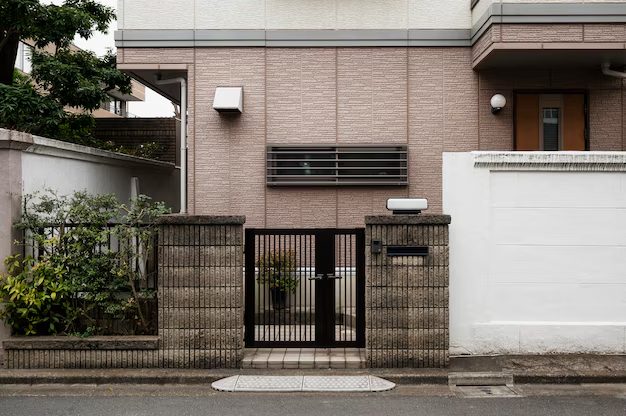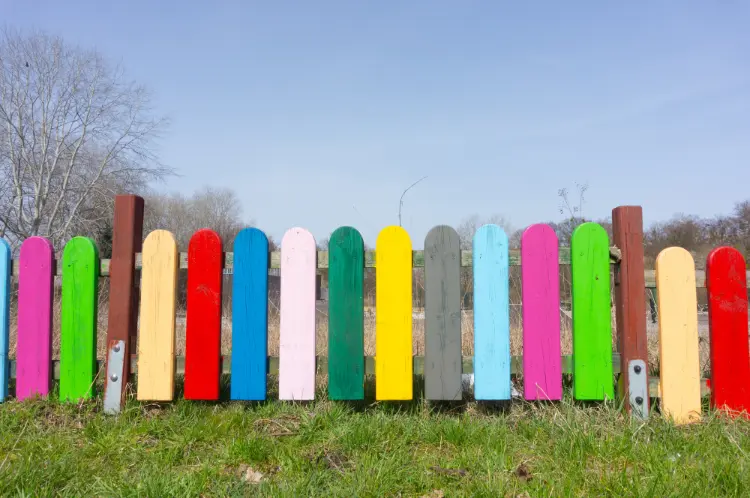
Choosing a color for your fence often turns out to be harder than choosing the fence itself. This makes sense – the color sets the mood for the entire property. It can highlight the architecture of your house or clash with it.
Many people pick a shade based on a small sample in the office and later feel disappointed when they see it on a larger scale. To avoid this, you need to consider not only personal preferences but also the laws of physics, practicality, and current trends.
The Language of Colors: What is RAL and Why Does it Matter?
In construction and design, abstract names like “sky blue” or “chocolate” are not used. Color perception is subjective – what looks like “dark gray” to one person may appear almost black to another. To avoid costly mistakes, the whole world uses the RAL standard.
What is it? RAL (Reichs-Ausschuss für Lieferbedingungen) is a German color standard created in 1927. The RAL Institute revolutionized color, breaking down the entire spectrum into precise mathematical formulas.
How is the code read? In the most popular classic palette (RAL Classic), each color has a unique four-digit number. The first digit indicates the group:
1xxx – yellows
3xxx – reds
6xxx – greens
7xxx – grays (the most popular group for fences)
8xxx – browns
9xxx – whites and blacks
Why do you need this? It’s your guarantee. If you choose RAL 7016 (Anthracite), you can be 100% sure that the powder coating on your aluminum profile, the mailbox enamel, and the garage door finish will be identical – even if made in different factories in different countries.
Current Trends – What’s in Style Now?
Anthracite (RAL 7016)
Unquestioned leader in recent years. Deep dark gray that changes shade depending on the lighting.
Style: perfect for hi-tech, loft, and minimalist homes.
Plus: versatile – matches white facades, wood, brick, and concrete. The safest choice if you’re afraid of making a mistake.
Classic Brown (RAL 8017 / 8019)
Dark brown or “Chocolate.” Traditional choice for houses with tile roofs.
Style: classic, country.
Plus: brown fences create warmth and coziness, harmonizing with garden greenery and tree trunks.
Light Gray and Metallic (RAL 7004 / 9006)
Choice for those seeking lightness.
Style: Scandinavian, Provence.
Plus: gray fences look fresh and don’t weigh down the space.
Practicality Battle: Dust and Sun
Aesthetics matter, but you also need to know how often you’ll wash the fence.
Dust and dirt: Contrary to myths, black and dark brown show dust the most. After rain, light streaks remain. The most practical colors are gray, beige, and silver – street dust is barely visible.
Texture matters: Glossy surfaces act like mirrors and show all stains and micro-scratches. Matte surfaces (textures like “matt” or “shagreen”) hide dust and minor imperfections.
Sun fading: Every pigment fades over time under UV. High-quality factory coatings minimize this effect.
Dark colors (black, brown) heat up more, but modern polymers withstand this.
Bright colors (red, blue, green) fade the fastest.
Gray shades (anthracite, graphite) are the most UV-resistant.
Psychology of Perception
Color affects how large your property feels.
Dark fences define clear visual boundaries – “compact” the property, making it cozy and secure.
Light fences blur boundaries – visually expand the yard, adding air and light.
Rule of Harmony
How do you integrate the fence into the architecture? Use the “color repetition” rule. The fence should “echo” one of the elements of the house.
The most common approach: match the roof color. A classic solution linking the highest point of the house to the perimeter in one frame.
You can also match window frames or downspouts. The main rule – do not introduce a fourth color if your walls, roof, and base are already colored.
A Smart Compromise
There’s no perfect color, but there is a conscious choice.
If style and modernity are your priority – choose anthracite (RAL 7016). A status choice that increases the visual value of your home.
If practicality and low maintenance are your priority – consider light gray tones or textured coatings. They forgive slight dust and keep a fresh appearance for a long time without washing.
Remember: you’ll see the fence color every day. Choose the shade that pleases you most, and quality coating will preserve it in any weather.
Hard to visualize the color on your property?
Choosing based on a small swatch is always risky. Better to see it once in place.
Send a photo of your house, and we’ll help you pick a RAL color that perfectly complements your facade and roof.