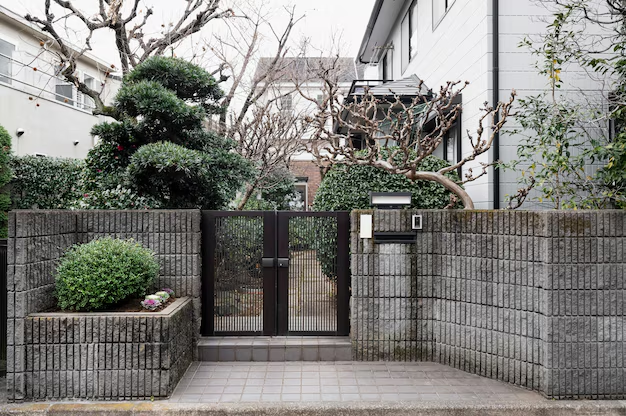
Residents of multi-family buildings often face the same problem. The courtyard turns into a public parking lot for neighboring offices. Noisy groups gather on the playground. The sense of security disappears.
The solution is to enclose the yard. Installing a fence and automatic gates immediately increases comfort and property value. However, in a condominium, this process is more complicated than in a private house – you need to reach an agreement with all owners.
We’ve prepared a step-by-step guide for building managers and initiative groups.
Step 1: Who owns the land?
Before planning a fence, check the property documents. You are only entitled to fence the area if the land under and around the building is privately owned by the apartment owners.
It often happens that the building is private, but the surrounding land belongs to the municipality. In this case, you cannot install a permanent fence. First, you’ll need to arrange a land lease or get approval for a light barrier through a special municipal procedure.
Step 2: Organize a meeting
Any change to common areas requires a legitimate decision. For this, a general meeting of the condominium owners must be convened.
The law requires strict adherence to procedure:
-
Post a notice of the meeting in a visible location at least 7 days in advance.
-
Clearly describe the agenda: “Decision on installing a fence and access control system.”
-
Make sure to record the meeting minutes.
Step 3: Voting and neighbors’ consent
This is the most difficult stage. Installing facilities on shared property usually requires a qualified majority (often 67% of the ideal shares of the common property – check the current rules in the Condominium Ownership Act – ZUES).
Obtaining neighbors’ consent is not always easy.
-
Argument for car owners: You will have a guaranteed parking space without outsiders.
-
Argument for pedestrians: The yard will become safe and quiet for children.
All decisions must be officially recorded in the Owners’ Book.
Step 4: Access control and emergency services
Installing a fence is not enough. You need to decide how people will enter. The access control system should be convenient for everyone.
The most popular options:
-
GSM module: Open via a phone call. Convenient because you don’t need to buy remote controls.
-
License plate recognition cameras: More expensive, but the most comfortable.
Important: You must ensure unobstructed access for emergency vehicles (ambulance, fire department, police) and municipal services (garbage trucks). Usually, the system is connected to a 24/7 dispatcher, or manual opening is allowed via a concierge.
Step 5: Project and implementation
With the general meeting minutes and land ownership documents, go to the municipality. The Chief Architect of the district issues permission to install a fence or barrier.
Installation can only begin after receiving the official document.
Financial matters
How are costs divided? The law suggests distributing expenses according to “ideal shares” (percentage of ownership in common property). At the meeting, however, owners can vote on a different method – for example, splitting the cost equally per apartment, or only among car owners. The main thing is to record the decision in the minutes.
Order and safety: the result of effort
The coordination process requires time and patience from the building manager. Collecting signatures, disputes at meetings, and visits to the municipality can take several months.
However, the results are worth the effort. A fenced yard radically improves quality of life:
-
Parking problems disappear.
-
Children can play outside safely.
-
The risk of theft and vandalism decreases.
-
The market value of each apartment in such a building automatically increases by 5–10%.
Once you go through this process, you create a comfortable environment for the next ten years.
Want to know more about owners’ rights?
Managing a multi-family building requires knowledge of both law and technology.
At Miradex Info, we regularly publish useful materials for building managers and proactive owners. Follow our updates to make your home better – smartly and legally.
Subscribe to our blog to receive expert advice first-hand.