Every construction starts from the ground. You can buy the most expensive panels and high-quality automation, but if you make a mistake with the foundation, in a year your fence will bend, and the gate will stop closing.
The foundation of a fence is its anchor – it holds the structure during strong winds and prevents it from sinking into the soil. But is it always necessary to pour tons of concrete?
There are two main types of foundations. Let’s understand which one you actually need.
Point (Pier) Foundation: Fast and Economical
This method is often called post installation. The technology is simple: you drill a hole only at the location of the supporting post, place the tube, and pour concrete. The space between the posts remains free (soil or grass).
Advantages:
-
Cost: minimum concrete required.
-
Speed: no long trenches or formwork needed.
When to choose: ideal for lightweight, airy fences (3D mesh, aluminum slats, picket fences) on dry and stable soil.
Strip (Continuous) Foundation: Reliable Monolith
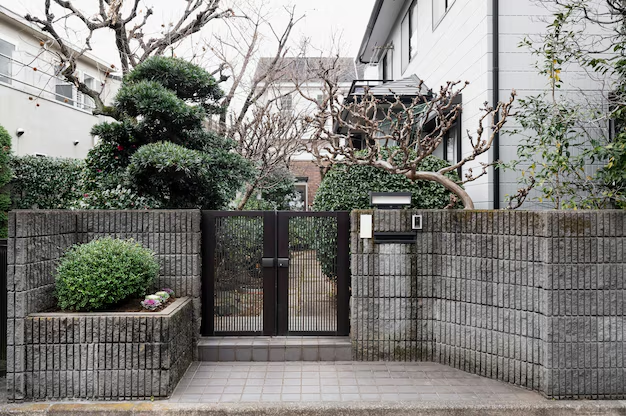
This is a continuous reinforced concrete strip around the perimeter – also called a concrete belt. The posts are embedded in this strip.
Advantages:
-
Rigidity: all posts are connected in a single system. If the soil moves, the fence shifts as a whole but does not warp.
-
Isolation: the concrete strip closes the gap under the fence. Neighboring dogs cannot enter, and rainwater from the street does not flow in.
-
Cleanliness: grass and weeds from the neighbor’s yard do not creep into your plot.
When necessary: for heavy fences (stone, brick, wrought iron) or on complex, swampy soils.
Factor #1: Weight of the Panel
The rule is simple – the heavier the top part, the stronger the base must be.
If you install light aluminum panels, a point foundation is enough. But if you plan a massive construction with brick posts, a point foundation will simply sink under the weight. The concrete strip acts like “skis,” distributing the weight over a larger area.
Factor #2: Tricky Soil
The type of soil is more important than the weight of the fence.
-
Sand and gravel: ideal soil. Water drains quickly – the economical point method works fine.
-
Clay and loam: dangerous soil. Clay retains water. In winter it freezes and expands – “soil heave” occurs. Ice pushes the concrete posts upward with great force. In this case, a strip foundation is more reliable, or the posts must be buried below the frost line.
Depth Matters
The most common beginner mistake is a shallow hole. Many think, “I’ll dig 40 cm, that’s enough.”
This guarantees problems. All foundations must be below the frost line. In Bulgaria, the depth varies from 60 to 80 cm depending on the region (deeper in mountains, shallower by the sea). If the bottom of the concrete is in the freezing zone, ice will move your fence every winter.
Reasonable Savings
Choosing a foundation is a balance between reliability and budget.
-
Want to save? If your plot is dry and the fence is light, choose point foundations. Reliable and inexpensive.
-
Need protection? If you worry about dog digging or rising clay, pour a concrete strip. Yes, more expensive, but it guarantees your fence will stay straight for 50 years.
Do not bury money in the ground unnecessarily, but don’t skimp on geology either. A cracked foundation cannot be repaired – it can only be demolished.
Planning Construction?
Mistakes during the groundwork stage are the most expensive. We help you navigate the technologies so you can control the workers.
Subscribe to our blog – we publish simple instructions for complex construction tasks.27