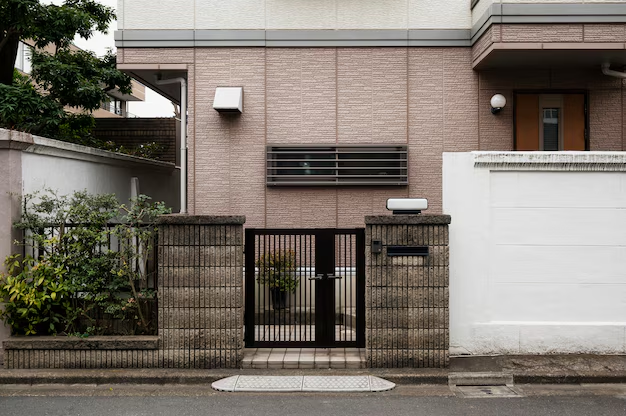
When completing the protective perimeter around a new home, owners often face a serious aesthetic challenge. Designing the front line requires coordinating several completely different structural elements — the stationary sections, the pedestrian wicket gate, and the main vehicle gate. People frequently buy these components from different suppliers at different times, resulting in complete visual chaos. The main gate turns out one shade, the intermediate profiles another thickness, and the overall style of the property is disrupted. Modern landscape architecture solves this problem with great intelligence through the use of unified factory fence panels and coordinated gate panels. This systematic approach allows the entrance and fence line to work in full visual and technological sync.
The Architectural Center: Why Each Individual Fence Panel Must Mirror the Style of the Gate
The main mistake when designing the property is treating the fence line as a mere backdrop. In modern exterior design, the perimeter plays the role of an architectural frame that is the first thing guests see from the street. If you choose a luxurious horizontal fence panel for the stationary sections but leave the gate doors with an ordinary vertical infill of welded mesh, the property immediately loses its prestigious status.
Using factory fence panels from Miradex (models such as Atlas, Piramida, Gamma, Terra) guarantees absolute technological identity throughout the entire perimeter. Our engineers design the infill of the vehicle gate frame according to the same algorithm by which inter-post panels are produced. This gives you identical profile thickness, consistent louver angle, and a perfectly matching shade from the international RAL catalog.
Miradex Gate Panels: Balance Between Weight and Structural Rigidity
The choice of decorative infill for the moving leaves is a critical engineering moment on which the life of your automation depends. If you opt for excessively heavy, massive forged or iron elements, the load on the load-bearing hinges and the electric motor gears increases geometrically. In strong wind, such a solid panel acts like a sail, quickly twisting the drive reducer.
The specialized gate panels from Miradex solve this problem decisively:
- Lightweight structure: Using high-quality aluminum or thin but precisely bent galvanized steel reduces the overall weight of the leaf by up to 40% compared to black metal.
- Aerodynamic angle: The specific geometry of jalousie-type louvers allows air currents to pass freely through the structure, minimizing wind pressure on the automation.
- Mechanical stability: Despite their low weight, the profiles possess exceptional structural rigidity thanks to factory internal stiffening ribs.
💬 Want to match the design of the stationary panels and gate doors without the risk of overloading the drive motor? Take advantage of a free preliminary 3D project and engineering estimate from the Miradex experts at miradex.info/konsultacziya/.
Industrial Coating Quality: Why the Factory Product Wins Over the Artisan Product
The primary technical defect of mass-market fence components is the rapid appearance of rust at joints. When louvers are welded or riveted by hand on site, the protective zinc coating of the metal is compromised. Under the influence of atmospheric moisture and spray from automatic irrigation systems, brown spots erupt at the welds and quickly destroy the paint.
The Miradex production line completely excludes manual assembly processes in the open air. Every modular fence panel is assembled using the mechanical locking method in special internal grooves, without weld seams. Before the powder coating is applied, the elements undergo sandblasting preparation and chemical phosphating. The paint is baked in industrial ovens at temperatures above 200°C, which encapsulates the steel and guarantees that the surface will not fade in the sun and will not require annual repainting for the next two decades.
Real-world case: The owner of a property in a gated community orders a beautiful louvered fence but decides to save on the gates and hires a local welding company to fabricate gate panels matching the fence design. The craftsmen weld the profiles and paint them with liquid spray paint. After just the first winter, due to snow settling and road salt, the paint along the bottom edge of the vehicle gate cracks, deep rust appears, and the leaf twists under wind influence and begins to jam on closing. The owner dismantles the compromised structure and orders certified Miradex factory gate panels, fully coordinated with the stationary perimeter. The entrance system regains its perfect smooth operation and luxurious architectural appearance.
Technical and Operational Fence Component Comparison Table
Below is a detailed engineering analysis of the different types of materials and execution methods for entrance systems.
| Technical criterion | Craft-welded iron panels | Low-budget plastic / PVC modules | Miradex premium systems (Aluminum / Steel) | Effect on site operation | Long-term financial efficiency |
|---|---|---|---|---|---|
| Anti-corrosion protection at welds | Low (manual paint application that quickly cracks) | Zero (PVC does not rust, but ages quickly) | Maximum (mechanical locking + powder baking) | Completely eliminates the appearance of brown rust spots | Saves costs on buying expensive paints every 3 years |
| Wind load on the automation | Critical (if the panel is entirely solid) | Medium (profiles lack structural rigidity) | Minimal (due to the aerodynamic louver angle) | Protects the electric motor gearbox from breaking | Eliminates costs for expensive drive repairs |
| Visibility of mounting elements | Visible weld seams, rivets, and self-tapping screws | Visible plastic joints with poor design | Fully concealed internal mounting of components | The structure looks flawless and clean from both sides | Increases the overall market value of the property |
| Response to UV rays and heat | Fading and cracking of alkyd coating | Permanent deformation and brittleness in winter | Absolute stability of molecular structure | Colors retain their original deep matte or gloss finish | Prevents the need for premature module replacement |
| Stylistic unity of the entrance system | Profile matching is difficult to achieve | Limited color selection from the RAL catalog | 100% coordination between fence, gate, and wicket | The property acquires a prestigious and complete architectural status | Long-term investment with high return |
##
Miradex Engineering Advice: How to Build a Complete Project
If you are in the process of planning the exterior fencing, stop treating the gates and stationary sections as two completely different elements. They must be ordered from one certified manufacturer with a unified material catalog. This guarantees that the profiles will have absolutely identical thickness, louver pitch, and mirrored geometry.
Rely on factory fence panels, which are secured to the posts using ready-made mounting clamps without on-site welding. This saves waiting time for construction crews and protects the site from contamination with sparks and slag.
Do not turn your home’s facade into a patchwork of compromise materials with a questionable appearance. Modern landscape architecture demands technical solutions that assemble easily, look luxurious, and work reliably in the open air under any climatic conditions. Contact the Miradex engineering department so we can develop a coordinated 3D project for your panels and gate systems to the highest European standards.
Request a free technical consultation today and receive a personalized offer tailored to the specifics of your entrance.