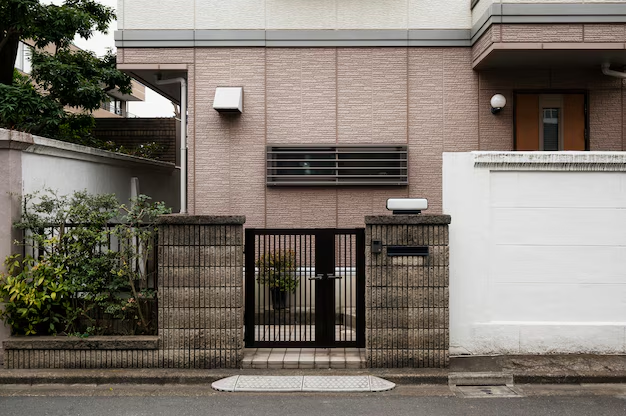
When a homeowner builds a private house, they think about beauty and privacy. When an owner builds a factory or logistics center, they think about assets.
The industrial perimeter is a complex engineering system. Here, the rules of private construction do not apply. Thin profiled sheets or decorative picket fences won’t stop intruders and won’t withstand harsh operational conditions.
Industrial fences are a separate class of structures. Let’s explore what distinguishes them and why saving on metal here is unacceptable.
Strength and durability: 2D vs. 3D
The most popular solution for industrial zones is mesh panels. Many people, however, confuse residential and industrial series.
For a private house, a 3D mesh with 3–4 mm wire is sufficient. For factory fences, this is not enough – the standard is reinforced 2D panels (Duos).
Construction: welded from thick rods with diameters of 5, 6, or 8 mm. The horizontal rod passes in two rows (on both sides of the vertical rod), creating an extremely rigid grid.
Strength: such solid constructions cannot be cut with ordinary pliers. They withstand accidental impacts from forklifts or truck bumpers without deforming.
Thanks to double reinforcement, the panel has enormous bending resistance. In an active industrial environment, where accidental collisions with equipment or vandalism attempts are possible, this construction maintains its geometry. This saves the owner from having to replace bent sections after every minor accident or harsh winter and ensures real long-term durability of the perimeter.
Transparency for control
Businesses often make the mistake of enclosing warehouse bases with solid concrete walls or profiled sheets. It may seem more secure.
In fact, modern business security standards require transparency:
No blind spots: security personnel and cameras must see what is happening behind the perimeter. If intruders attempt to dig under or climb over a solid wall, nothing can be observed.
Base for special equipment: a solid mesh fence is ideal for barbed wire (razor wire), motion and vibration sensors. On vibrating profiled sheets, sensors give false alarms.
A transparent perimeter works for prevention – security can spot suspicious activity early and gain valuable minutes to respond. A solid wall hides the intruder, while a see-through fence acts as a control tool.
Logistics: gates for giants
Industrial facilities involve intensive traffic:
Width: gates must allow two trucks or oversized cargo to pass simultaneously. Openings are often 8–12 m wide, requiring reinforced industrial beams and heavy-duty rolling mechanisms.
Frequency: if the gate opens 300 times a day, a residential motor would burn out in a week. Industrial automation with oil bath systems is used, designed for continuous operation.
Every entrance failure causes logistical stoppages, truck queues, and direct financial losses. Industrial equipment is therefore designed with high safety margins to prevent downtime even under the harshest weather conditions.
Harsh environment
Factories often release active chemical substances into the air. Warehouses are near highways with exhaust gases and pollutants.
Ordinary paint quickly peels in such conditions. For industrial sites, the zinc layer is critical – hot-dip galvanization (dipping the finished product in a zinc bath) provides metal protection for 50 years, even in industrial zones.
The fence replaces on-site security
Investing in a professional industrial fence directly reduces operational costs.
A reliable, high, and transparent perimeter with barbed wire psychologically deters intruders better than a “Security” sign. It allows a reduction in the number of live patrols. Moreover, high-quality metal (2D panels) does not require annual repairs after winter, reducing the company’s budget load.
In business, safety is the foundation of stability. A weak fence is a risk no serious company can afford.
Planning a perimeter for an industrial facility?
Industrial facilities require customized design – accounting for logistics, unloading zones, and security requirements.
Contact us – we can help calculate a project of any complexity, from a small warehouse to a high-security factory.