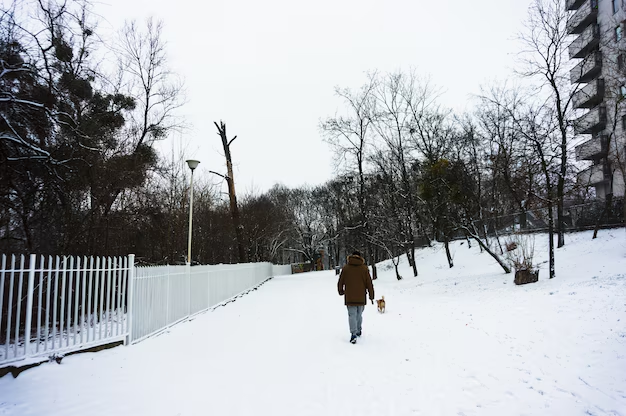
With the arrival of the first frosts, many property owners freeze all projects until spring. There is a belief that quality construction is only possible in warm weather.
This myth comes from the last century, when technologies were primitive. Today, professional construction companies work year-round. Moreover, ordering installation off-season can even be more cost-effective and convenient than during the peak of summer.
Let’s see how modern technologies overcome the cold and why winter is an excellent time to upgrade your perimeter.
The main concern: will the concrete freeze?
The most challenging stage in winter construction is concrete work. Everyone knows: at sub-zero temperatures, the water in the mix turns to ice – the concrete cannot gain strength and crumbles by spring.
This is true, but only for ordinary concrete. Professionals use special chemical additives – plasticizers and antifreezes.
How does it work? The additives prevent the water from freezing even at –10 °C or –15 °C. The cement is able to react with the water.
Exothermy – during curing, the concrete releases heat. With the correct proportion of additives, the foundation “warms itself” from the inside and gains full strength just as reliably as in summer.
So, if the crew uses a quality mix with winter additives, there’s no need to worry about the foundation’s reliability.
Drilling frozen ground
The second obstacle is considered the impossibility of digging frozen soil.
Indeed, digging frozen soil by hand with a shovel is hard and costly. But installers use powerful gas-powered drills. For professional equipment, the frozen top layer (usually 10–20 cm) is not a problem – the drill goes through it in seconds, and the soil underneath is soft.
Even more – winter installation has an unexpected advantage: cleanliness. In autumn or spring, the site is muddy with puddles – the machinery damages the grass, workers spread clay. In winter, the ground is hard, and the snow protects the grass. After the work, the site remains perfectly clean.
Three reasons to build in winter
If technology allows it – why wait? Winter installation gives the owner three serious advantages:
No queues – in spring and summer, good crews are booked 2–3 months in advance. You wait and get frustrated. In winter, the workload is lower – they can arrive the next day after the order.
Garden care – in winter, your plants are dormant. If workers accidentally touch a rose bush or step on a tulip bed, the plants are unharmed because they are resting under the snow.
Cost – the most pleasant bonus. In winter, demand for construction materials drops. Many companies offer seasonal discounts on metal and labor to keep production running.
By ordering a fence in January or February, you save money, time, and nerves, while getting the same quality result.
Limitations: when it’s better to wait
Of course, there are situations where installation is impossible.
Extreme cold – if the temperature drops below –20 °C, the hydraulics of the equipment fail, and it is dangerous for people to work outside.
Snowstorm – heavy snowfall makes precise laser marking of the site impossible.
In such cases, the work is simply postponed for a few days until the weather stabilizes. In mild Bulgarian winters, such days are few.
Strategy of anticipation – why winter is the best time to start
The habit of “freezing” construction until warm weather is a relic of the past and today works against the owner. By postponing installation until May, you fall into the perfect storm: metal and concrete prices rise seasonally, and the best crews are already booked on large projects. In the end, you spend more money and nerves for the same result.
Winter installation is the choice of strategically minded people.
First – financial benefit. The construction market is cyclical – in winter, manufacturers give discounts to maintain turnover. You buy premium materials at budget prices.
Second – quality of life. Imagine the perfect May: sunshine, first greenery, a barbecue with friends.
Scenario “Waiting for spring”: In May, your plot becomes a muddy construction site. Instead of relaxing – you listen to the sound of grinders, mix mud, and supervise workers until July.
Scenario “Winter construction”: the dirty work happens in February, when you’re already home anyway. The snow hides the traces. By the first warm weekend, your plot is already clean, fenced, and fully ready for the leisure season.
Do not fear the cold – modern chemistry makes concrete obedient even in frost. Fear losing time. Winter installation is the easiest way to greet spring in comfort and peace, while your neighbors are still trying to reach the contractor.
Want to know more about fence construction?
We share technologies that break stereotypes and save you money.
Subscribe to our blog to avoid construction myths and make informed decisions.