The urban environment is a high-risk zone for any construction. Fences in parks, sports grounds, or apartment courtyards endure stresses that private homeowners rarely imagine.
Teenagers climb on them, hit them with balls, lock their bikes to them, try to shake them, or draw on them with markers. A standard “summer” fence loses its appearance within a single season under such conditions.
For municipal facilities and public areas, special engineering solutions are required. How can you install a fence that cannot be broken without specialized equipment? Let’s look at the main principles of anti-vandal protection.
Geometry: don’t give them a handhold
The first rule of protection is the correct shape. Vandals rarely carry power tools. Their “weapon” is their body weight and feet.
Vertical instead of horizontal: Fences with horizontal slats act like ladders. It’s easy to climb and bend the profiles with weight. An anti-vandal fence should be made of vertical bars or slats – there’s nowhere to step.
Reinforced ribs: A flat sheet bends easily when kicked. Reinforced profiles have a complex geometry with ribs for strength. This rigidity allows the structure to “spring” under impact without deforming.
Fastening: mission impossible
The second challenge in public spaces is theft. If a section can be unscrewed with a regular wrench, sooner or later it will be stolen (for metal or just vandalism).
Professional anti-vandal solutions use clever fasteners:
Break-away nuts: When tightened, the hex head breaks off, leaving a smooth cone that cannot be gripped with a wrench or pliers. Such a fence can only be removed with a grinder.
Hidden installation: All screws are hidden inside the posts or under decorative covers. The intruder simply doesn’t see what to unscrew.
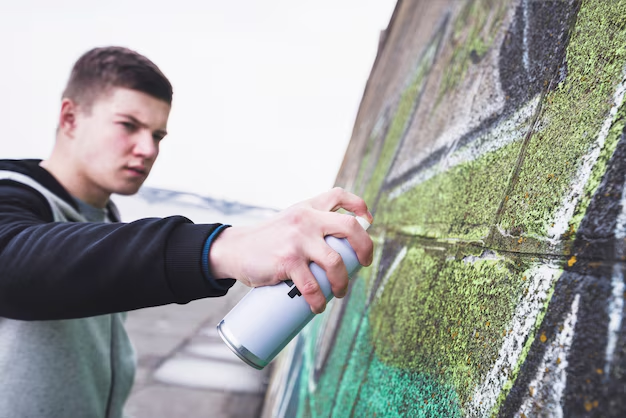
The street artist’s nightmare: graffiti protection
Graffiti-covered walls and fences are a scourge in modern cities. Removing paint is expensive and damages the coating.
How can we prevent it from the design stage?
No canvas – no drawing: The best protection is the absence of a solid surface. Mesh fences (3D mesh or picket-style) simply don’t provide enough area for painting – it’s impossible to make a readable tag or drawing on them.
Textured surfaces: If a solid fence is needed, choose a rough texture (“shagreen”). Markers and spray paint don’t adhere well to textured surfaces – the paint smears and the “vandal fun” disappears. Smooth surfaces are much easier to draw on.
Coating durability
In public spaces, fences are constantly touched, hit with bags, or scratched with keys. Ordinary paint wears down to the metal quickly. Industrial-grade durability is needed – powder coating with increased layer thickness and higher adhesion. It acts like armor, protecting the metal even under strong mechanical stress.
Savings on maintenance
Special reinforced fences may seem expensive, but the economics of public spaces are calculated differently.
A cheap fence made of thin mesh or profiled sheets in a city park needs repair every six months – replacing bent sections, covering graffiti, installing new locks. Over five years, maintenance costs far exceed the initial installation cost.
A high-quality anti-vandal fence is a “once and for all” investment:
Impossible to break without tools.
Impossible to disassemble.
Difficult to paint or deface.
Such a structure saves municipal or condominium budgets, remaining clean and safe for decades despite the aggressive urban environment.
Interested in urban planning?
Creating a comfortable and safe city environment is a science. We share the best European practices for improving parks, courtyards, and public areas.
Subscribe to our blog to learn how to make your city better and safer.