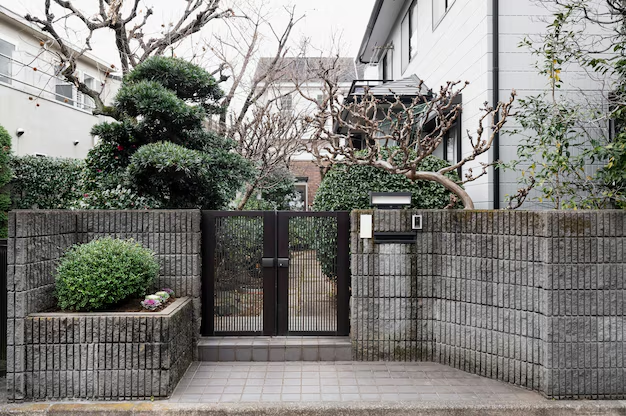
For a long time, private homeowners believed in one rule: “My home is my fortress.” They took it literally. People built three-meter concrete walls and installed solid metal sheets to completely shut themselves off from the world. The fence served as a rigid boundary, separating “ours” from “theirs.” As a result, entire streets turned into narrow corridors between solid walls.
But today, this approach is outdated. The world has changed. By 2025, architects are choosing a new path—openness, light, and integration into the environment. Europe no longer builds “bunkers.” Lightweight visual constructions are now in fashion. This is not just about aesthetics; it reflects a new approach to safety and comfort. Why don’t tall walls work anymore? How are new rules reshaping our cities? Let’s explore the main trends.
Trend #1: Reducing Visual Noise
Modern fences no longer need to dominate. A solid tall fence on a small plot creates a “well effect.” It presses on the psyche, steals sunlight, and turns a cozy yard into a closed box.
The 2025 trend favors visual lightness. Constructions that allow air and light to pass through are in vogue:
-
Horizontal slats (louvers)
-
3D mesh panels with greenery
-
Lattice profiles
The fence becomes a filter, not a wall.
Trend #2: Passive Safety
There is a paradox studied in contemporary urbanism. Many believe that a solid wall is safe—but statistics show otherwise.
Once a thief climbs over a solid fence, they are in complete safety. From the street, no one sees them. They can break windows or doors for hours without being noticed.
A transparent or semi-transparent fence works on the principle of “Eyes on the Street.” If your yard is visible, neighbors or passersby can notice suspicious activity. This is called “passive safety.” Openness protects better than isolation.
Trend #3: Environmental Integration (Biophilia)
Future architectural design aims for harmony with nature. The fence should not “cut” the landscape.
If your house is near a forest or park, the fence should blend into the background. Trends include:
-
Natural colors: anthracite, deep green, brown
-
Textures: metal with wood-like coating or matte surfaces
-
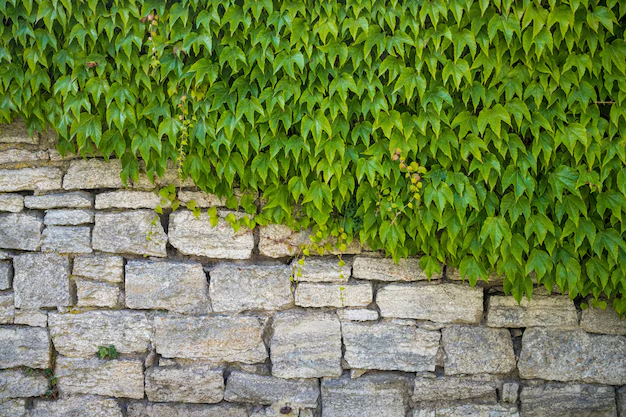
Greenery: using the fence as support for climbing plants
Trend #4: Respect for Urban Environment
We are used to thinking only about our own plot. But the appearance of your fence shapes the entire street—that is, the urban environment.
In Europe, municipalities often prohibit solid fence facades. Why? Walking along a street squeezed between two solid walls is unpleasant and intimidating. This creates a “tunnel effect.”
A beautiful, permeable fence signals respect for neighbors and the city. It makes the street brighter, wider, and safer for everyone.
Summary: The New Standard of Living
The main trend for 2025 is balance.
We are not asking you to live on display for everyone. We offer smart solutions. For example, louvered fences hide your private life from direct views while letting light and air through, without creating a bunker-like feeling.
A modern home is part of the world, not a refuge from it. When choosing a fence, think not only about boundaries but also about how you will feel within them every day.
Want to learn more about contemporary architecture?
The world is changing rapidly. What was normal yesterday may be outdated today.
At Miradex Info, we track all urbanism changes and safety standards. We regularly publish trend reviews, analyses of new materials, and expert advice.
Stay with us to ensure your home and plot are not only secure but also modern.