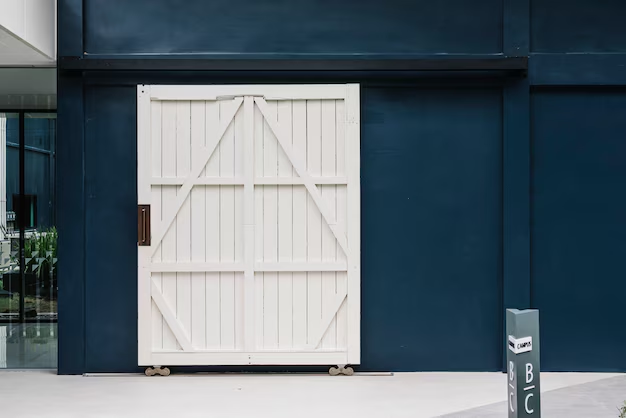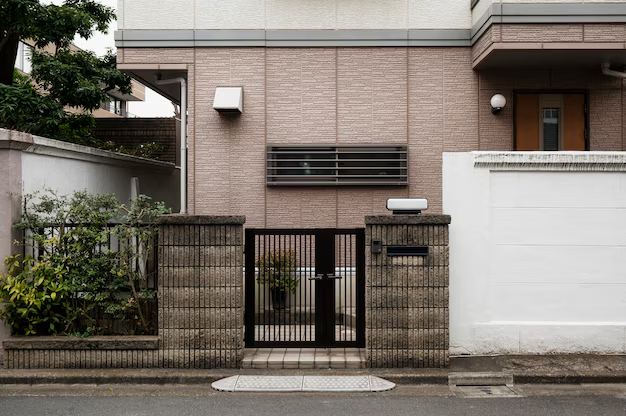
Automatic sliding gates are installed at the vast majority of new private properties across Europe. They open along the fence line and require no swing clearance. However, treating this as a simple purchase decision is an oversimplification. The type of construction, drive motor power, and level of automation determine not just convenience but the service life of the entire system.
A recurring situation: the owner orders attractive sliding gates, the installers fit whatever drive motor is available. After 8–12 months the motor overheats and fails — the gate panel turned out to be heavier than accounted for. Selecting the right drive for the actual weight of the panel prevents this entirely.
Types of Sliding Gates by Track System
The difference between construction types becomes apparent during installation and even more so during long-term use.
| Type | How it works | Advantages | Limitations | Best for |
|---|---|---|---|---|
| Ground track (rail) | Bottom roller runs along a recessed ground rail | Reliable, handles any weight | Rail collects debris; raised threshold | Standard installation |
| Cantilever (suspended) | Panel hangs from an upper bracket arm | No rail or threshold; performs well in snow | Heavy-duty support post required | Feature entrances, snowy regions |
| V-roller (rail-free) | Bottom roller runs directly on the ground surface | Simpler installation; lower cost | Light panels up to 150 kg only | Light mesh gate installations |
Calculating the Required Drive Motor Power
Gate panel weight is the key parameter when selecting a drive. Undersized power leads to rapid wear and failures.
- Up to 300 kg — light-duty drives: BFT Deimos A, Nice Road 400. Suitable for mesh gates and small residential properties.
- 300–600 kg — FAAC 740, Came BX-78, BFT Ares. The standard for most private homes with metal panels.
- 600–1,000 kg — for wide entrances over 5 m or heavy solid gate panels.
- Over 1,000 kg — commercial properties with high-frequency operation.
A practical tip: always choose a drive with a 20–30% power reserve above the calculated panel weight.
💬 Find the optimal drive motor for your gate’s weight and dimensions. Consultation https://miradex.info/konsultacziya/
Gate Automation: What Modern Systems Offer
- GSM module — opens via a phone call or SMS. Reliable where Wi-Fi is unstable.
- Gate wifi controller — smartphone control from anywhere, push notifications, full opening log.
- Auto-close timer — the gate closes automatically after a set period following opening.
- Signal lamp — flashes amber during gate movement. A safety essential.
- Photocells — stop the gate if an obstacle is detected.
- Video intercom integration — see who is at the gate and open it directly from your phone.
Common Installation Mistakes
- Incorrect gate panel weight calculation — the most frequent cause of premature drive motor failure.
- No end stops — the panel strikes the post, progressively damaging the roller mounting.
- Ground rail installed without a drainage gradient — water pools and can freeze the roller in winter.
- Insufficient travel distance — minimum: gate width plus 0.3–0.5 m.
- No earthing on the automation unit — the drive is vulnerable to lightning-related surges.
Conclusion
Automatic sliding gates: convenience, security and aesthetic entrance design in a single structure. The right choice of track system, drive power, and automation level determines satisfaction with the installation year after year.
📖 Read also on the Miradex blog:
Sliding or Swing Gates? | Smart Home System: Gate Automation
💬 Book a free consultation — a Miradex specialist will help you find the right solution for your property.