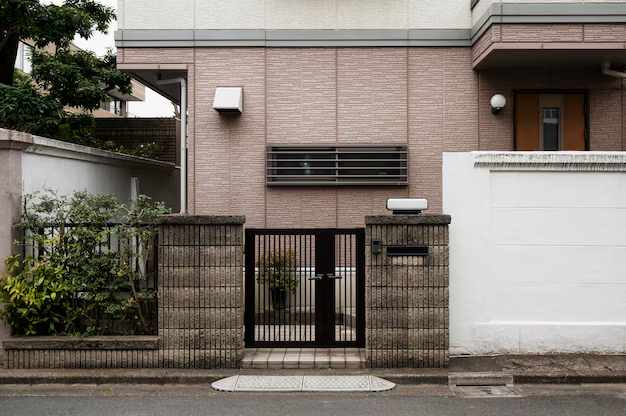
An anti climb fence is a complete system in which every structural element makes climbing over difficult or impossible. Spikes on the top rail are just one of the tools. Anti intruder fencing costs little more than a standard fence: it is entirely a question of making the right selection from the outset.
Protection against intrusion and protection against accidents near a swimming pool are two distinct tasks. In the first case, the goal is to stop an unauthorised person from outside. In the second, it is to protect a child or animal from a hazardous zone within the property.
How a True Anti Climb Fence Works
Effective anti climb fencing is built on the principle of providing nothing to grip and nowhere to stand.
- Vertical pointed profiles (spear tops) with no horizontal rails — no foothold to push off from.
- Fence spikes or decorative finials on the top rail — make gripping the top edge with the hands impossible.
- Height of at least 2.0–2.4 m — scaling without specialist equipment is practically impossible.
- Smooth post surfaces with no protruding fixings — no climbing points along the post.
- No horizontal members in the lower third of the fence — removes the option of using them as footholds.
Fence Spikes: Types, Applications and Legal Restrictions
| Type | Security level | Aesthetics | Where used |
|---|---|---|---|
| Decorative spear tops (lance top) | Medium | High | Private homes, street-facing facade |
| Flat spikes (cat whiskers) | High | Neutral | Rear boundary, storage areas |
| Razor wire / barbed tape | Maximum | Low | Industrial sites, warehouse perimeters |
| Plastic anti-climb strips (rolltop) | Low–Medium | Neutral | Plant protection, decorative use |
An important legal point: fence spikes directed outward towards a public pavement are governed by local authority regulations. In most EU jurisdictions, spikes positioned below 2.2 m directed towards a pavement are prohibited. Always verify requirements with the local authority before ordering.
💬 We will help you select the right security fence type for your site and local regulations. Free consultation https://miradex.info/konsultacziya/
Barrier Fencing: How It Differs from Anti-Climb
Barrier fencing is a broader concept. It describes any structure that physically restricts movement. A barrier fence does not necessarily prevent climbing — it physically demarcates a prohibited zone or channels movement. It delivers both intrusion protection and privacy in a single solution.
Pool Fencing: Mandatory Requirements
Pool safety regulations across the EU require open swimming pools to be enclosed.
- Enclosure height — a minimum of 1.2 m (1.5 m recommended by practitioners).
- Gap between vertical bars — no more than 10 cm.
- Gate latch — self-closing, opening only from the outside or at a height unreachable by a child.
- No horizontal members in the lower half of the enclosure.
- Material — aluminium or stainless steel, resistant to chlorinated water.
- Distance from the pool edge — at least 1.0 m.
Conclusion
Pool fencing is a distinct product category with specific requirements, not a standard fence. Anti climb fencing and pool safety fencing address two different but equally important aspects of property safety.
📖 Read also on the Miradex blog:
Security Without Bars: Transparent Barriers | Fencing and Property Safety
💬 Book a free consultation — a Miradex specialist will help you find the right solution for your property.