Cities are getting bigger, and nature within them is diminishing. We live surrounded by concrete, glass, and asphalt. That’s why a new trend is gaining popularity worldwide: biophilic design.
Its essence is simple: we bring nature back into our daily lives by integrating it into architecture. And your fence can become a central element of this transformation.
Forget boring, solid walls. A modern fence is the perfect base for a vertical garden.
Metal and greenery: the perfect union
At first glance, cold industrial metal and warm, living nature seem like incompatible opposites. But modern design principles say the opposite: the most striking solutions are built on contrast.
In this union, each material plays its role:
Play of colors: Many people mistakenly paint fences green to “blend” with the garden. This is a mistake. A green fence disappears against the foliage, creating a dull, washed-out patch. The best choice for biophilic design is deep, dark tones: anthracite (RAL 7016) or black. Dark metal acts as a “shadow” and stays in the background. Against it, lush greenery looks incredibly bright, contrasting, and voluminous. It’s the “gallery” effect: the fence is the wall, and the plant is the artwork.
Order and chaos: Nature is inherently chaotic. Branches grow unpredictably, creating visual noise. Metal slats with their strict geometry and straight lines provide a necessary “frame.” They organize the greenery, giving the garden a structured, architectural look without extra effort from the gardener.
Texture contrast: The smooth, flawless surface of powder-coated metal highlights the complex, rough textures of leaves and bark. This combination enriches the visual and tactile experience of the property without making it feel industrial.
This is why architects in loft and high-tech styles love using metal in gardens. It doesn’t compete with nature; it emphasizes its beauty.
Vertical gardens: saving space
If your plot is small, every square meter counts. A vertical garden allows greenery without taking up lawn space.
Use your fence as support (a trellis). Climbing plants can grow along slats or mesh panels up to 2–3 meters high. You get a full, living fence that occupies just 20–30 cm in width.
Why metal is better than wood
Many people grow plants on wooden fences. This is a mistake.
Leaves retain moisture after rain. Wood under the dense green cover doesn’t dry out, starts to rot, and develops mold. In 3–4 years, such a fence deteriorates.
Metal is different. Quality metal fences are powder-coated and baked in an oven. The coating creates a sealed armor. Metal isn’t affected by the “greenhouse effect” under the leaves and serves as a reliable support for decades without maintenance.
Which plants to choose?
The choice depends on your goals and climate:
Evergreen wall: Ivy grows slowly but provides year-round greenery, even in winter.
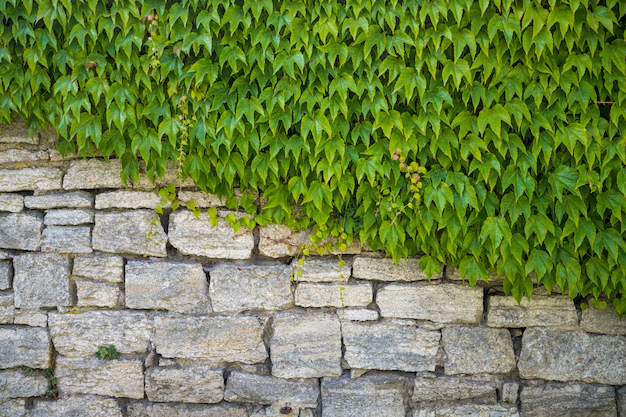
Fast coverage: Virginia creeper grows quickly, creating a dense wall in one or two seasons. In autumn, its leaves turn bright red – spectacular.
For beauty: Climbing roses or clematis require care but turn the fence into a blooming feature.
Important: mature vines can be heavy. If planning dense greenery, ensure the fence posts are solidly anchored in concrete.
Eco-design and microclimate
A green wall isn’t just for beauty. It improves quality of life:
Cooling: Leaves evaporate moisture, lowering temperatures around the fence on hot days.
Purity: Plants act as filters, capturing street dust and exhaust gases.
More than just a fence – a new quality of life
Biophilic design isn’t a temporary trend but a response to modern humans’ need for tranquility. Transforming an ordinary fence into a vertical garden changes its function. From a solid wall that only marks property boundaries, it becomes an active element of the landscape – a source of oxygen and aesthetic pleasure.
This approach proves that technology and ecology can go hand in hand. By choosing metal as a base, you gain practicality: durability, corrosion resistance, and minimal maintenance. By adding plants, you gain emotion: living texture, coolness, and the rustle of leaves.
Don’t be afraid to experiment. Even a narrow strip of soil along a metal fence can become your personal park. It’s the simplest and most effective way to elevate the quality of life in a private home and create your green oasis amid a noisy world.
Want to learn more about landscaping trends?
The design world never stands still. We gather the best landscaping and gardening ideas from across Europe.
Subscribe to our blog to find inspiration for your garden.