When it comes time to enclose your perimeter, the main question for a property owner is: how will the entrance gate open?
Many people decide based only on appearance or habit – some like the aristocratic classic look with two leaves, while others prefer the technological style with a single solid leaf. Design, however, comes second. First and foremost are the rigid geometry of your plot and the local climate conditions.
A gate is a complex mechanism you’ll use at least twice a day. Choosing the wrong type can lead to losing convenient parking space, overloading the hinges, or spending hours clearing snow just to get to work. Let’s compare the two most popular systems in detail.
Swing Gates: Tradition with Nuances
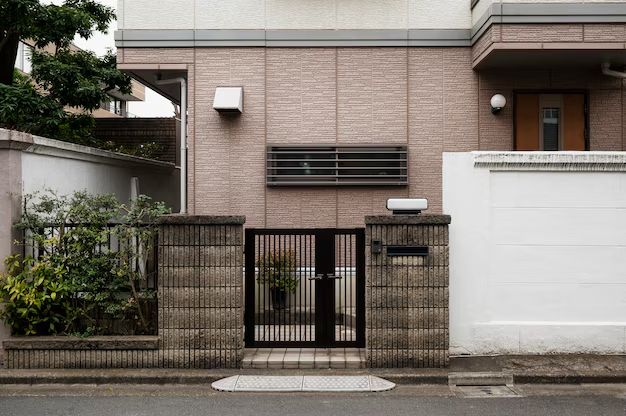
These are the traditional double-leaf gates (also called radial by engineers), mounted on hinges attached to posts. A solution tested for centuries, but with technical limitations.
Main drawbacks:
“Dead zone” – the leaves move in an arc. The entire opening area must be perfectly clear.
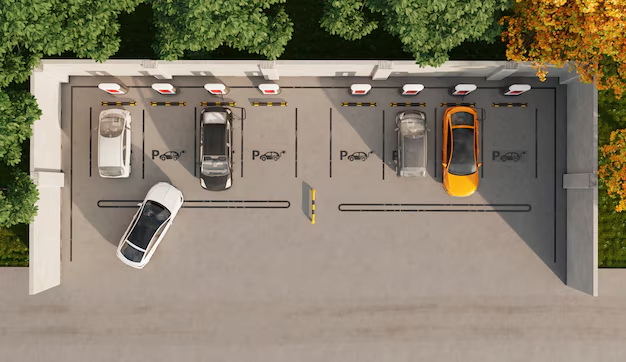
Parking – you can’t park close to the gate; leave 2–3 meters so the leaf doesn’t hit the bumper. Short yards may not accommodate the car.
Winter – any snowdrift or ice along the leaf’s path can block operation, requiring daily shoveling.
Wind – the most dangerous factor. Open leaves act like sails; if not fixed, they can hit your car or tear off the hinges.
Best use: Swing gates are ideal for narrow but long plots where there’s no room alongside the fence, as well as for archway entrances and classic architectural styles.
Sliding Gates: Levitation Technology
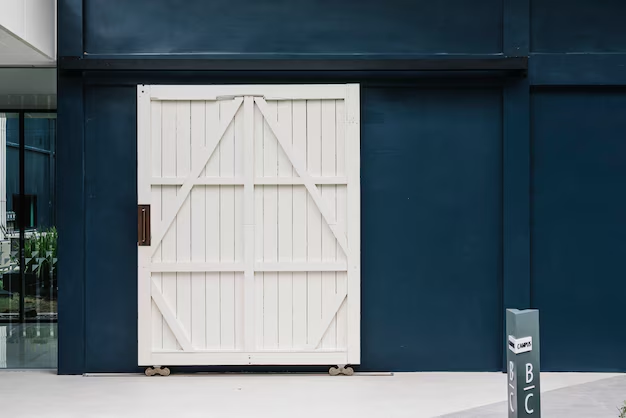
Modern cantilever sliding gates are the choice of pragmatists. Their main feature: the leaf doesn’t touch the ground – it hangs on a special beam and slides along the fence.
Advantages:
Maximized space – the gate doesn’t occupy useful yard space, ideal for tight parking.
Wind resistance – when closed, the leaf is firmly fixed in the catch. Minimal stress on the mechanisms.
No ground track – unlike older rail gates that clogged with mud and ice, cantilever systems “float” above the ground and can handle drifts up to 10–15 cm.
Installation complexity: To move, the gate needs a counterweight. The total length of the structure is always 40–50% longer than the opening. For a 4 m opening, 6 m of free space along the fence is required. Obstacles like trees or a pedestrian gate can make installation impossible.
Automation and Budget Considerations
The type of gate directly affects the cost of automation:
Swing gates require two motors (one per leaf) and a complex control unit, with wiring through the second post.
Sliding gates need only one motor, easier to install, more reliable, and cheaper to maintain.
Aesthetics vs. Functionality
Choosing between swing and sliding systems is a choice between classic aesthetics and modern efficiency.
Swing gates look welcoming and ceremonial – perfect for classic estates with space for a wide arc. They do, however, require constant care: snow clearing, hinge lubrication, and fixing during strong winds.
Sliding gates are the “workhorse” – simpler in appearance but comfortable, space-saving, snow-tolerant, and storm-proof. If you want a reliable “install and forget” mechanism and have space for lateral sliding, cantilever systems are undoubtedly the best investment for your family’s convenience.
Complex Terrain or Narrow Plot?
Not sure if there’s enough space for sliding? Concerned that swing leaves will block your entrance? A miscalculation could prevent the gate from opening fully.
Send us your plan or a photo of your entrance – we’ll calculate the movement trajectory for free and advise which system will physically fit your plot.